The overarching mission of this Division of the North Carolina Department of Agriculture & Consumer Services is to protect the health and welfare of consumers by enforcing Federal and State laws, rules, regulations and policies designed to ensure that all meat and poultry products distributed to the consumer are wholesome, unadulterated, and properly labeled.
This webinar will provide insight into the jurisdiction of this Division, wholesale inspection qualifications and requirements, insight into retail meat & poultry sales, meat handlers registration and more!
Meat & Poultry Division
While the Division is headquartered in downtown Raleigh, the Meat & Poultry Inspection Division (M&PID) has employees across the state of North Carolina. M&PID employes an estimated 118 employees including: meat & poultry inspectors, area supervisors, veterinarians, compliance officers, trainers, and support staff.North Carolina is one of 29 states with a meat inspection program that operates alongside USDA's Food Safety and Inspection Service to ensure safe products are reaching our consumers.M&PID Jurisdiction & Oversight
- Red meat slaughter and/or further processing establishments and poultry further processing establishments
- Facilities that slaughter and/or process meat and poultry products from animals of an individuals own raising for their own consumption
- Wholesale Meat Operations
- Register Meat & Poultry Handlers
- Review Poultry Exempt Operators
M&PID 2023 Statistics
| 206,436,120 pounds of red meat | 63,211,520 pounds of poultry | 4,857,761 pounds of catfish | 12,328 adult cattle, 757 calves |
| 286,841 swine | 15,774 sheep | 23,901 goats | 450 animals condemned at slaughter |
Wholesale Meat & Poultry Operations
Those who are looking to wholesale meat & poultry products must apply for a Grant of Inspection. NCDA&CS will grant a temporary, 90-day conditional grant of inspection. During that time period, the company must validate the grant and show all requirements are being met. Some of these requirements include, but are not limited to: sanitary operations, facility requirements, written HACCP and recall plans.- No fees, permits or licensing is required for a Grant of Inspection
- However, if a company works outside of their approved hours of operation, anything over the 40-hours of inspection covered by NCDA&CS, the processing operation must pay for the additional services
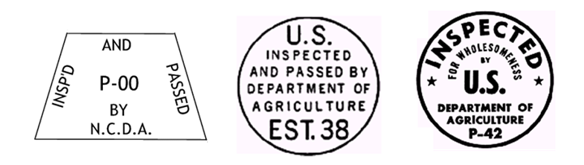
Both intrastate and interstate products under the inspection of NCDA&CS M&PID must bear marks of inspection on their products.
Retail Meat & Poultry Products
All retail meat operations fall to the local Health Department’s jurisdiction. Some examples of when this occurs could be at meat display cases or restaurants selling their meat products at farmers markets.- Restaurants must maintain control of the product; they cannot outsource the transportation or sale of their meat products.
- Products must be properly labeled
- Products must be protected from contamination
- Products must be kept at safe temperatures during transportation and while at the market
- Operations must contact the market they want to retail at and ensure meat sales are permissible. Each market may have different guidelines for sales.
- Employees at the Market should also retain permit documentation from their local health Department, in case asked by regulators.
Who needs a Meat Handlers registration?
Meat Handlers registration is required for those not currently under the inspection of the M&PID or the USDA. This includes both red meat and poultry items. Entities with a meat handlers registration cannot further process or repackage meat products. The meat handlers registration should be maintained as proof of compliance when asked by retailers, such as farmers markets
| Door-to-door meat salespeople | Farmers who have their animals slaughtered and packaged for sale |
| Warehouses & distributors |
Additional Resources:
USDA HACCP Guidance
USDA Guidebook for the Preparation of HACCP Plans
USDA Small & Very Small Plant Guidance
Meat & Poultry Division Contacts
| Lisa Benton | Technical Assistance Manager | elizabeth.benton@usda.gov |
| NCDA&CS Meat & Poultry Division | https://www.ncagr.gov/divisions/meat-poultry-inspection | (919) 707-3180 |
Webinar hosted on May 10, 2024.

“This work was supported by the intramural research program of the U.S. Department of Agriculture, National Institute of Food and Agriculture, Food Safety Outreach Program 1030908. The findings and conclusions in this preliminary publication have not been formally disseminated by the US Department of Agriculture and should not be construed to represent any agency determination or policy.”